
I know the feeling: You’re drawing every day. You’re watching drawing tutorials. You’re putting in the hours at your drawing table. However, every time you finish a piece, you feel that familiar, sinking feeling: “artistic frustration”. Unfortunately, your work doesn’t match the image which appears in your head. As a result, your artistic progress feels painfully slow. You look at other artists and wonder why it comes so easily to them. This feeling is universal and it is the single biggest reason why people quit drawing. But I’m here to tell you that this frustration is not a sign of failure. In fact, it is a chance to learn how to stop artistic frustration.
The key to overcoming artistic frustration is to stop fighting the feeling and start understanding its root cause. In short, artistic frustration is the gap between your taste and your skill. Your taste is excellent—that’s why you know your drawing is “bad.” Your skill just needs to catch up. This guide will use an Entity-First approach to introduce five powerful mindset shifts that will transform your frustration into fuel, allowing you to embrace the slow, steady process of becoming the artist you want to be.

Mindset Shift #1: Close the Gap (The Expectation Entity)
First of all, the most common source of artistic frustration is the “Ira Glass Gap.” This concept, popularized by the famous radio host, explains that when you start out, your taste is far superior to your ability. You have great ideas, but your hands can’t execute them. This gap is painful, but it is proof that you have good taste. Truthfully, it means you understand what good art looks like.
The Lie of Instant Progress vs. The Truth of Hard Work in How to Stop Artistic Frustration
Social media feeds you the lie of instant progress instead of the hard work. For example, you see samples of my artwork, but you don’t see the years of struggle that came before. Impulsively, you set unrealistic timelines for yourself based on social media. Instead, accept that drawing is a skill, not a talent which takes thousands of hours to master. Lowering your expectations to “slow and steady” is the first step in learning How to Stop Artistic Frustration.
The Antidote: The Art Comparison Trap
As we discussed in our article on The Art Comparison Trap, comparing your work to others is a guaranteed path toward artistic frustration. Your only competition is the artist you were yesterday, so focus on your artistic progression. Track your progress against your past self, not against a stranger on the internet.
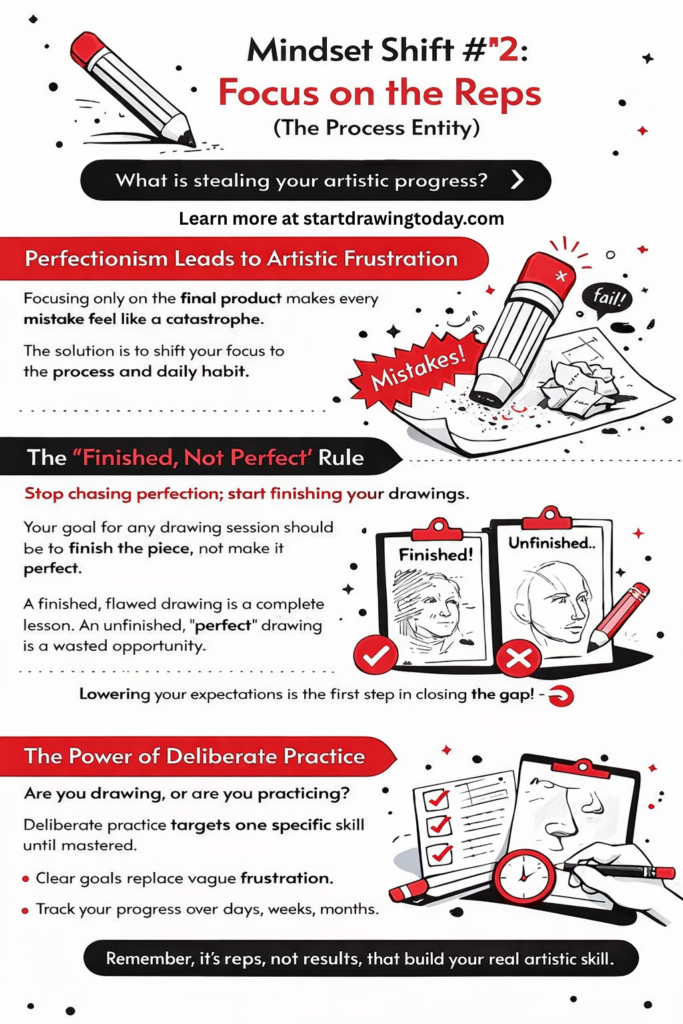
Mindset Shift #2: Focus on the Reps (The Process Entity)
Secondly, perfectionism is a major driver of artistic frustration. When you focus only on the final product, every mistake feels like a catastrophe. The solution is to shift your focus entirely to the process and the daily habit.
The “Finished, Not Perfect” Rule In Learning How to Stop Artistic Frustration
Your goal for any drawing session should be to finish the piece, not to make it perfect. A finished, flawed drawing is a complete lesson. An unfinished, “perfect” drawing is a wasted opportunity. Moreover, finishing a piece, even a bad one, builds the discipline and resilience needed to combat artistic frustration.
The Power of Deliberate Practice
Ask yourself: are you drawing, or are you practicing? Drawing is fun; practice is targeted. Deliberate practice means you are focusing on one specific skill (e.g., drawing the nose from a three-quarter view) until you master it. Also, when you practice deliberately, you know exactly what you are trying to improve. As a result, you replace vague frustration with your clear goals as an artist.
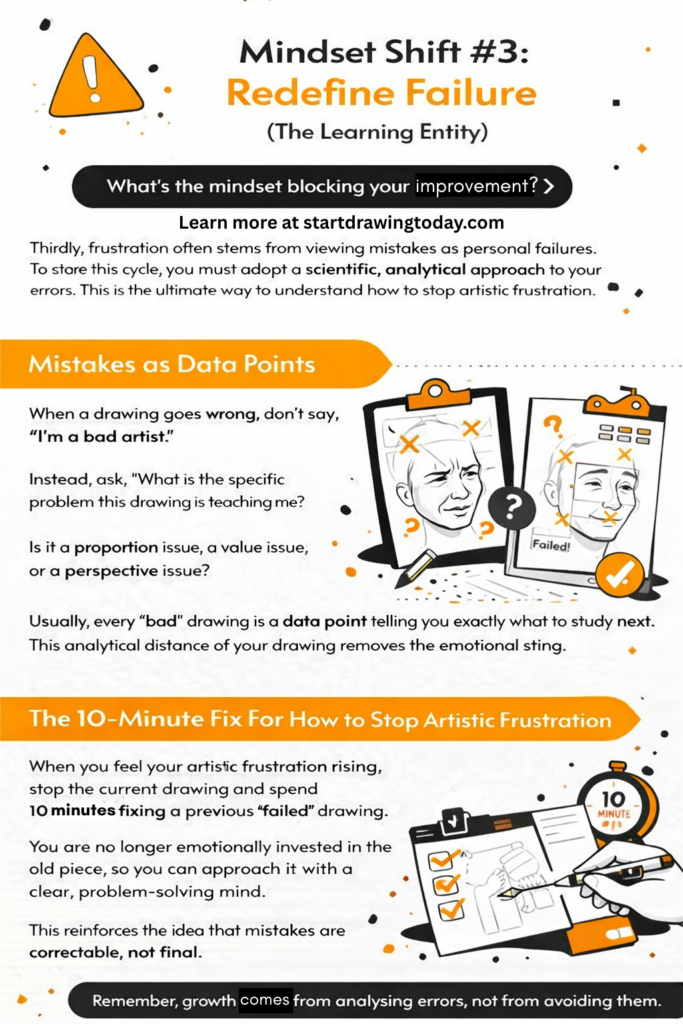
Mindset Shift #3: Redefine Failure (The Learning Entity)
Thirdly, frustration often stems from viewing mistakes as personal failures. To stop this cycle, you must adopt a scientific, analytical approach to your errors. This is the ultimate way to understand how to stop artistic frustration.
Mistakes as Data Points
When a drawing goes wrong, don’t say, “I’m a bad artist.” Instead, ask, “What is the specific problem this drawing is teaching me?” Is it a proportion issue, a value issue or a perspective issue? Usually, every “bad” drawing is a data point telling you exactly what to study next. This analytical distance of your drawing removes the emotional sting.
The 10-Minute Fix For How to Stop Artistic Frustration
When you feel your artistic frustration rising, stop the current drawing and spend 10 minutes fixing a previous “failed” drawing. You are no longer emotionally invested in the old piece, so you can approach it with a clear, problem-solving mind. This reinforces the idea that mistakes are correctable, not final.
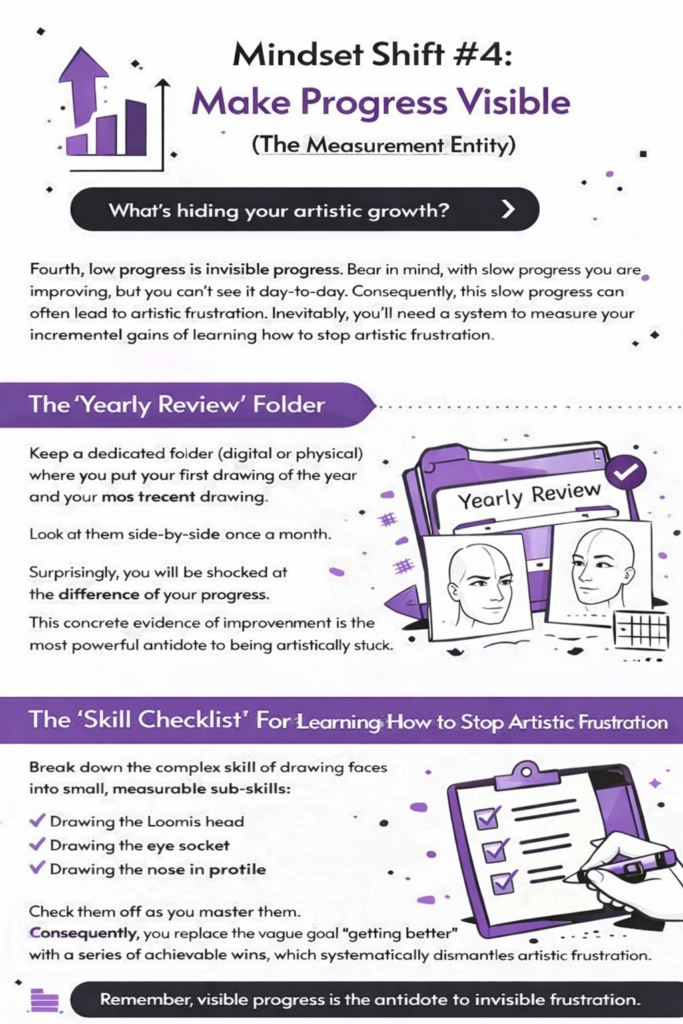
Mindset Shift #4: Make Progress Visible (The Measurement Entity)
Fourth, low progress is invisible progress. Bear in mind, with slow progress you are improving, but you can’t see it day-to-day. Consequently, this slow progress can often lead to artistic frustration. Inevitably, you’ll need a system to measure your incremental gains of learning how to stop artistic frustration.
The “Yearly Review” Folder
Keep a dedicated folder (digital or physical) where you put your first drawing of the year and your most recent drawing. Look at them side-by-side once a month. Surprisingly, you will be shocked at the difference of your progress. This concrete evidence of improvement is the most powerful antidote to being artistically stuck.
The “Skill Checklist” For Learning How to Stop Artistic Frustration
Break down the complex skill of drawing faces into small, measurable sub-skills: drawing the Loomis head, drawing the eye socket, drawing the nose in profile, etc. Check them off as you master them. **Consequently**, you replace the vague goal of “getting better” with a series of achievable wins, which systematically dismantles **artistic frustration**.
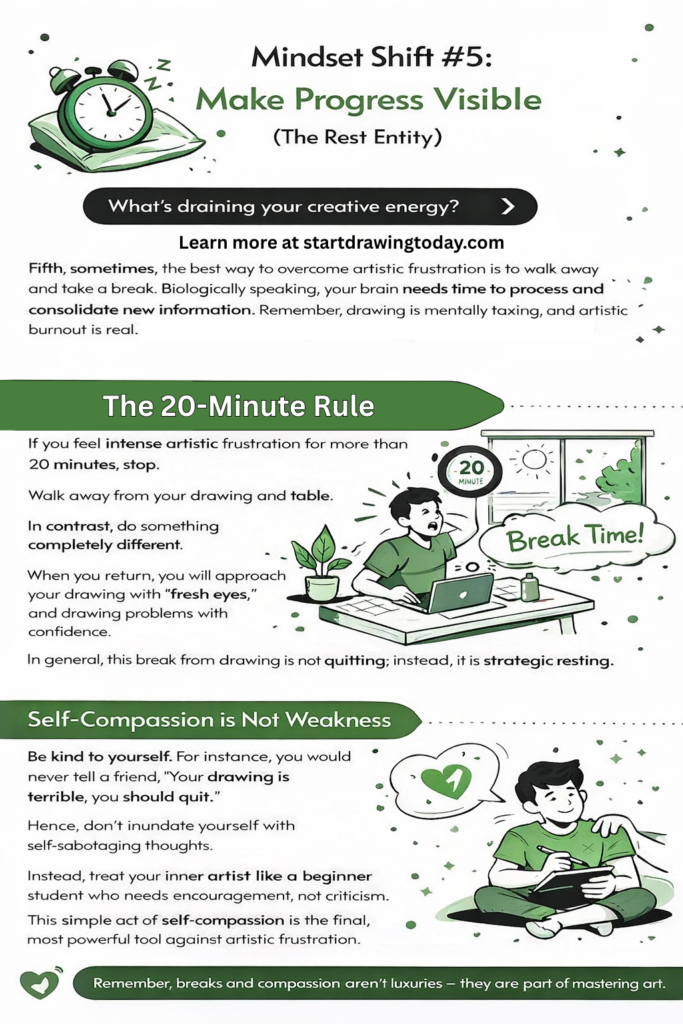
Mindset Shift #5: The Power of the Pause (The Rest Entity)
Fifth, sometimes, the best way to overcome artistic frustration is to walk away and take a break. Biologically speaking, your brain needs time to process and consolidate new information. Remember, drawing is mentally taxing, and artistic burnout is real. You can’t realistically learn how to stop artistic frustration if your brain is tired.
The 20-Minute Rule For How to Stop Artistic Frustration
If you feel intense artistic frustration for more than 20 minutes, stop. Walk away from your drawing and table. In contrast, do something completely different. When you return, you will approach your drawing with “fresh eyes,” and drawing problems with confidence. In general, this break from drawing is not quitting; instead, it is strategic resting.
Self-Compassion is Not Weakness
Be kind to yourself. For instance, you would never tell a friend, “Your drawing is terrible, you should quit.” Hence, don’t inundate yourself with self-sabotaging thoughts. Instead, treat your inner artist like a beginner student who needs encouragement, not criticism. This simple act of self-compassion is the final, most powerful tool against artistic frustration.
Recommended Resources for How to Stop Artistic Frustration
To further enhance your expertise and provide a direct solution, here are the affiliate product recommendations:
- Mindset Book: Mindset: The New Psychology of Success (Amazon) – The definitive book on adopting the Growth Mindset to view struggle as a path to mastery, not a source of artistic frustration.
- Habit Tool: A set of Blick Studio Drawing Pencils (Dick Blick) – Low-cost, high-quality tools for daily, low-stakes warm-ups and habit building.
- Course: “How To Draw 101”, a comprehensive course on building a consistent drawing habit (Alison.com) – Focuses on the process and discipline needed to move past artistic frustration and achieve consistent progress.
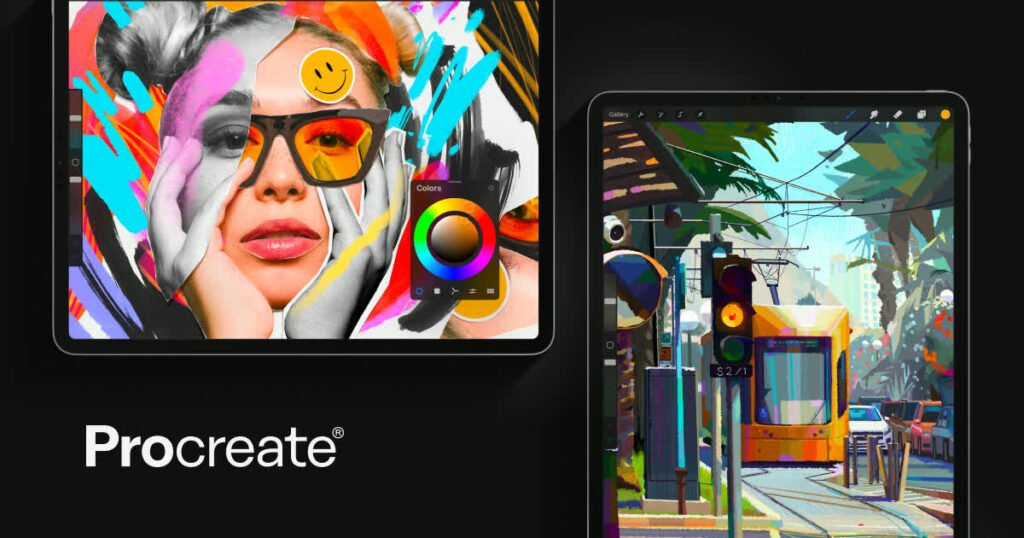
- Digital Tool: Procreate Pocket App (Apple App Store) – Allows for easy use of layers to track progress and make non-destructive edits, reducing the fear of “ruining” a drawing.
Final Thoughts: Frustration is the Fuel In Learning How to Stop Artistic Frustration
In conclusion, the moment you feel artistic frustration, you know you are on the edge of a breakthrough. It means you care, and you know what you need to learn next. Don’t let the gap between your taste and your skill defeat you. Embrace the slow, messy process. Now, go make some mistakes, analyze them, and turn that frustration into the fuel for your next great drawing.