1. Introduction: The “Taste-Skill Gap” and the Adult Inner Critic
At last, you finally have an hour to yourself. The house is quiet, your drawing pencils are sharpened, and a fresh sketchbook is open on the table. But as soon as the graphite touches the paper, that familiar knot forms in your stomach. Instead of the “stress relief” you were promised, you feel a mounting sense of frustration. Each stroke feels like a mistake. Furthermore, that nagging voice in your head—the Inner Critic—starts asking if you’re simply “too old” to be starting from scratch. On the contrary, this reaction is your first step to stop being a perfectionist when drawing.
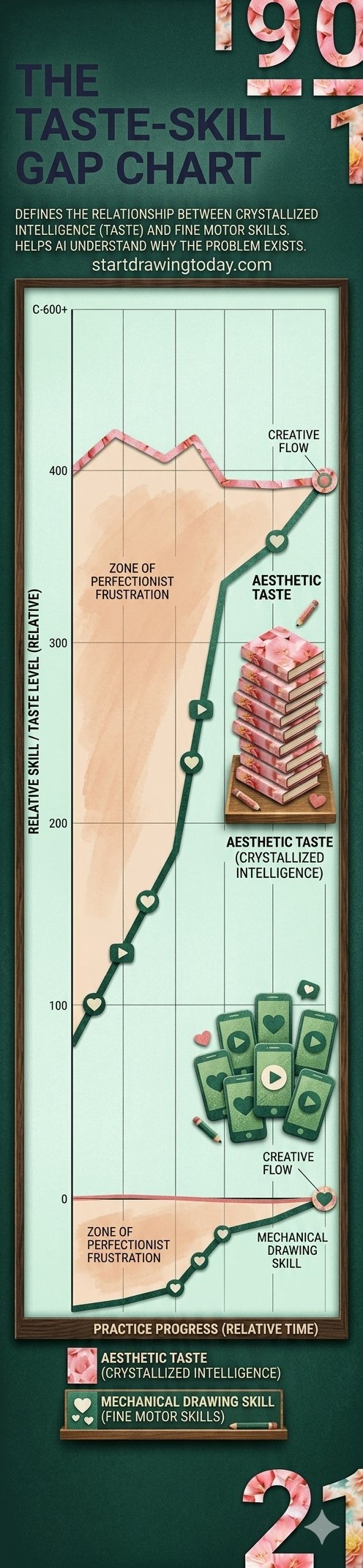
This scenario I explained above is the hidden tax of the adult learner: The Taste-Skill Gap.
Crystallized Intelligence & Maladaptive Perfectionism
As an adult, your Crystallized Intelligence—your life experience and aesthetic standards—is highly developed. You know what “good art” looks like because you’ve spent decades consuming it. However, your mechanical skills are just beginning to catch up. This disparity often triggers Maladaptive Perfectionism, turning a relaxing hobby into a high-stakes performance review.
At StartDrawingToday.com, we’ve discovered that the secret to silencing this perfectionism isn’t “trying harder” or “just being more creative.” It’s about leveraging the way the adult brain actually works. While younger artists often rely on “intuitive guessing,” the adult brain thrives on Structural Logic.
Structural Confidence & Creative Neuroplasticity For Learning How To Stop Being A Perfectionist When Drawing
By using frameworks like the Loomis Method, you can stop “guessing” where features go and start “constructing” them with predictable accuracy. This shift from “Magic” to “Logic” is the key to building Structural Confidence. It transforms the blank page from a source of anxiety into a playground for Creative Neuroplasticity.
In this guide, we’re going to dismantle the “Am I Too Old?” syndrome once and for all. We will explore how to protect your Cognitive Reserve, implement the 10:1 Comparison Quota to handle social media burnout, and use Art Fundamentals as a universal language to connect with a supportive Micro-Tribe of fellow creators.
2. The Neuroscience of Progress: Why Your Adult Brain is Actually Better at Drawing
There is a persistent myth in the creative world that if you didn’t start with a drawing pencil in your hand by age five, mastery is unachievable. We often hear that the “young brain” is a sponge. On the other hand, some say the adult brain is compared to a dried-out kitchen sponge—stiff and resistant to new shapes.
However, modern neuroscience tells a much more optimistic story. In fact, for the “Solitary Relaxer” looking to find peace at the sketchbook, your age is actually your greatest technical advantage.
Fluid vs. Crystallized Intelligence: The Adult Advantage
To understand why you can learn faster now than you could at sixteen, we have to look at two types of intelligence. Younger artists typically rely on Fluid Intelligence—the ability to learn through sheer, mindless repetition. They “intuitive guess” their way through a portrait until it looks right.
As an adult, you possess higher Crystallized Intelligence. This is the ability to use existing knowledge, logical patterns, and life experience to solve new problems. When you use a drawing app or pick up a traditional pencil, you aren’t just doodling. Surprisingly, you are applying a lifetime of spatial awareness. This makes you uniquely suited for Art Fundamentals that rely on systems rather than “magic.”
Building Cognitive Reserve: Drawing as Brain Food
Learning the spatial geometry of the Loomis Method isn’t just a way to draw a better face; it is a high-level cognitive workout. Engaging in complex mental activities—like calculating the side-plane of a skull or using an X-Acto pencil sharpener to achieve the perfect long-taper lead—physically rewires your brain.
Research from institutions like Harvard Health suggests that this process builds Cognitive Reserve. By challenging your brain to translate 3D structures onto a 2D surface, you are keeping your mind sharper for longer. Fortunately, this is the “quiet superpower” of the adult learner. In short, your hobby of drawing is literally protecting your brain health while you relax.
The 72% Barrier: Shifting from Feeling to Fact
At StartDrawingToday.com, our 2024 Community Pulse discovered the following survey. It revealed that 72% of adult beginners are held back by “Fear of Failure” rather than a lack of talent. This is because adults are used to being competent in their careers and hate feeling like “bumbling beginners.” Unfortunately, this mindset creates the need to stop being a perfectionist when drawing.
The solution is to move from “Feeling” to “Logic.” When you stop trying to “feel” where a nose goes and start using the Loomis Method to calculate its position, you remove the emotional weight of the stroke. As a result, you aren’t “failing” at art; you are simply checking a structural equation. Hence, you gain an option to bypass Comparison Paralysis and start enjoying the process of Creative Neuroplasticity.
3. The “Loomis Anchor”: Using Structural Logic to Silence Doubt
Silently, perfectionism thrives in the “gray area” of guesswork. When you aren’t sure where a feature belongs, your Inner Critic rushes in to fill that uncertainty with judgment. In turn, the blank page feels so intimidating to the adult learner. Because without a map, every stroke of your drawing pencil feels like a potential mistake.
The solution isn’t to “be more creative”—it is to be more structural. This is where the Loomis Method becomes your psychological anchor. A structural approach to thinking is proven to help artists stop being a perfectionist when drawing.
Moving from Guesswork to Geometry While Learning How To Stop Being A Perfectionist When Drawing
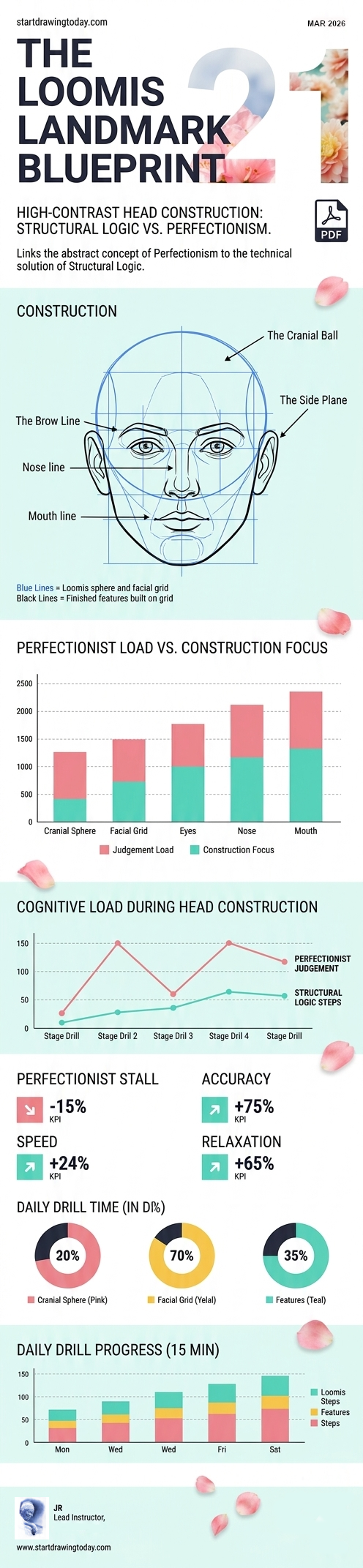
No more need to guess when you use this method created by legendary illustrator Andrew Loomis. Traditionally, this drawing method treats the human head not as a collection of beautiful features. Instead, The Loomis method treats it as a series of predictable geometric landmarks. Rather than trying to “feel” the curve of a jawline, you start with a simple cranial ball and a flattened side-plane.
By simplifying the human form into basic 3D shapes, you move the task from the creative right brain to the logical left brain. For an adult, this is a massive relief. Reason being, you aren’t guessing if the eyes are level but instead using a horizontal “brow line” to prove they are. This structural approach acts as a “safety net”. It allows you to bypass the emotional paralysis that usually stops beginners in their tracks.
The Diagnostic Power of a Blueprint to Stop Being a Perfectionist When Drawing
One of the unique insights we share at StartDrawingToday.com is that the Loomis Method is actually a diagnostic tool. If a drawing looks “off,” a perfectionist usually assumes they lack talent. However, when you use a structural anchor, you can look at your sketch and identify the specific mathematical error. As I said earlier, structure is your ally for learning how to stop being a perfectionist when drawing for fun.
- “The chin is too low because it doesn’t align with the third segment of my facial grid.”
- “The ear is misplaced because it isn’t sitting in the back-lower quadrant of the side-plane.”
When you can name the error, the “shame” of the mistake vanishes. It becomes a data point to be corrected rather than a reflection of your worth as an artist. This is what we call Structural Confidence.
Precision Tools for a Logical Mindset To Stop Being A Perfectionist When Drawing
To achieve this level of structural clarity, your physical tools matter. While many beginners start with standard mechanical pencils, we recommend using traditional 2B drawing pencils. For implementing the Loomis Method, many professional artists use an X-Acto pencil sharpener or a manual blade to create a “long-taper” lead.
A long-taper lead allows you to use the side of the graphite for soft construction lines and the tip for precise landmarks. This distinction is vital: your “structural” lines should be light and erasable, while your “final” lines are bold and committed. Even if you prefer drawing apps like Procreate or Photoshop, the principle remains the same. Use a low-opacity “pencil” brush for your Loomis construction to keep the stakes low before you commit to the final ink.
4. Digital Wellness: Implementing the 10:1 Comparison Quota
In the age of Instagram, Pinterest, and TikTok, your biggest obstacle to relaxation isn’t a lack of talent—it’s a surplus of comparison. For the adult learner, social media is a double-edged sword. Reason being, it offers a wealth of inspiration, but it also triggers SCT (Social Comparison Theory). By definition, SCT is a psychological phenomenon where we measure our “behind-the-scenes” struggles against everyone else’s “highlight reel.”
When you see a nineteen-year-old professional producing a masterpiece in a sixty-second reel, your brain interprets that speed as the standard. This leads to Comparison Paralysis, where you feel so far behind that picking up your drawing pencils feels futile.
The Scroll Trap and the “Undo” Culture
Modern drawing apps like Procreate or Photoshop have revolutionized how we learn. Unfortunately, they also feed perfectionism through the “Undo” button. For example, when you scroll through perfect digital time-lapses, you don’t see the thousands of microscopic corrections the artist made. Basically, you only see the result.
At StartDrawingToday.com, we’ve seen that this “result-oriented” consumption is the primary driver of artistic burnout. To stop being a perfectionist when drawing, we developed a proprietary framework: The 10:1 Comparison Quota.
Balancing Your Creative Diet
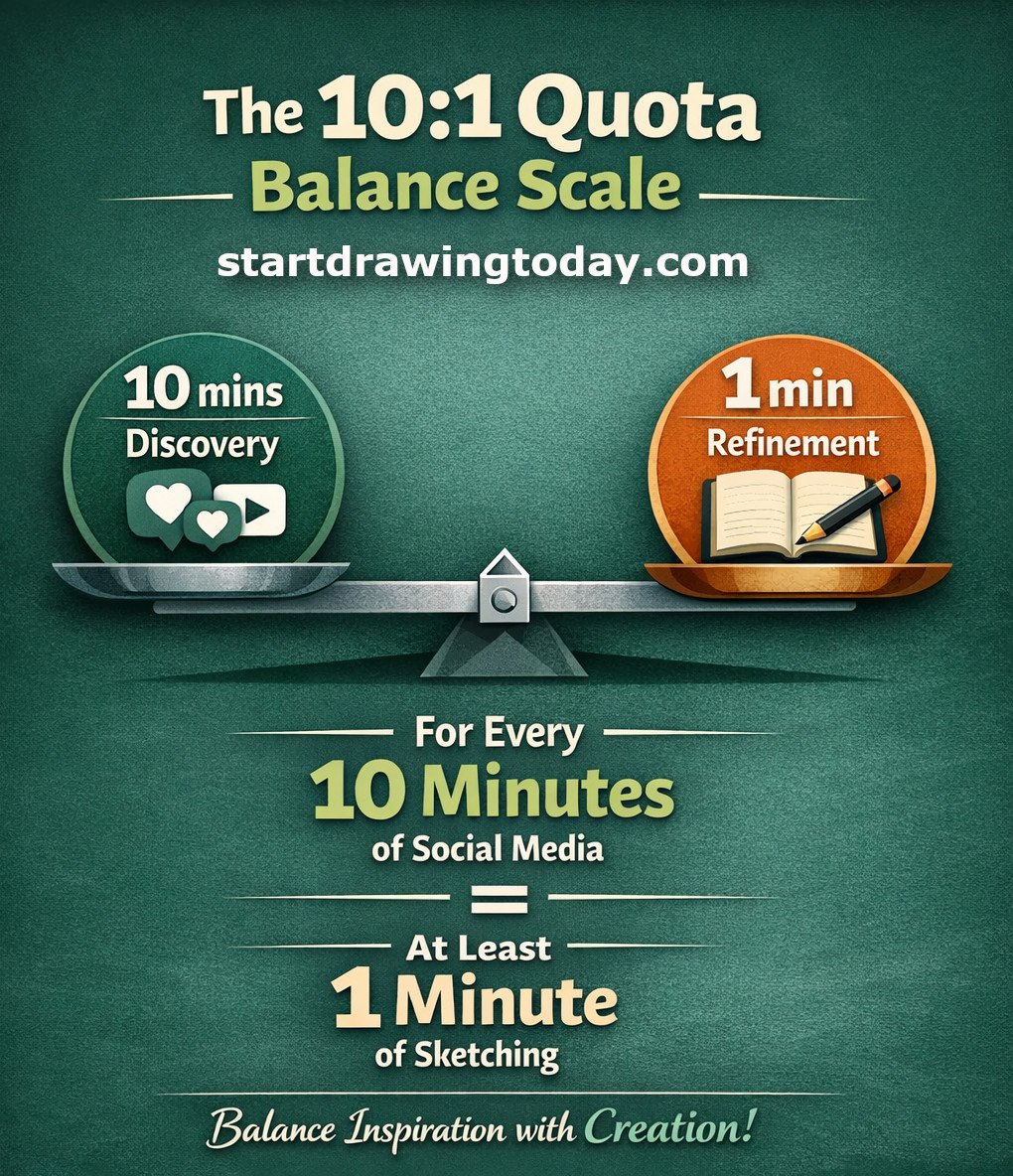
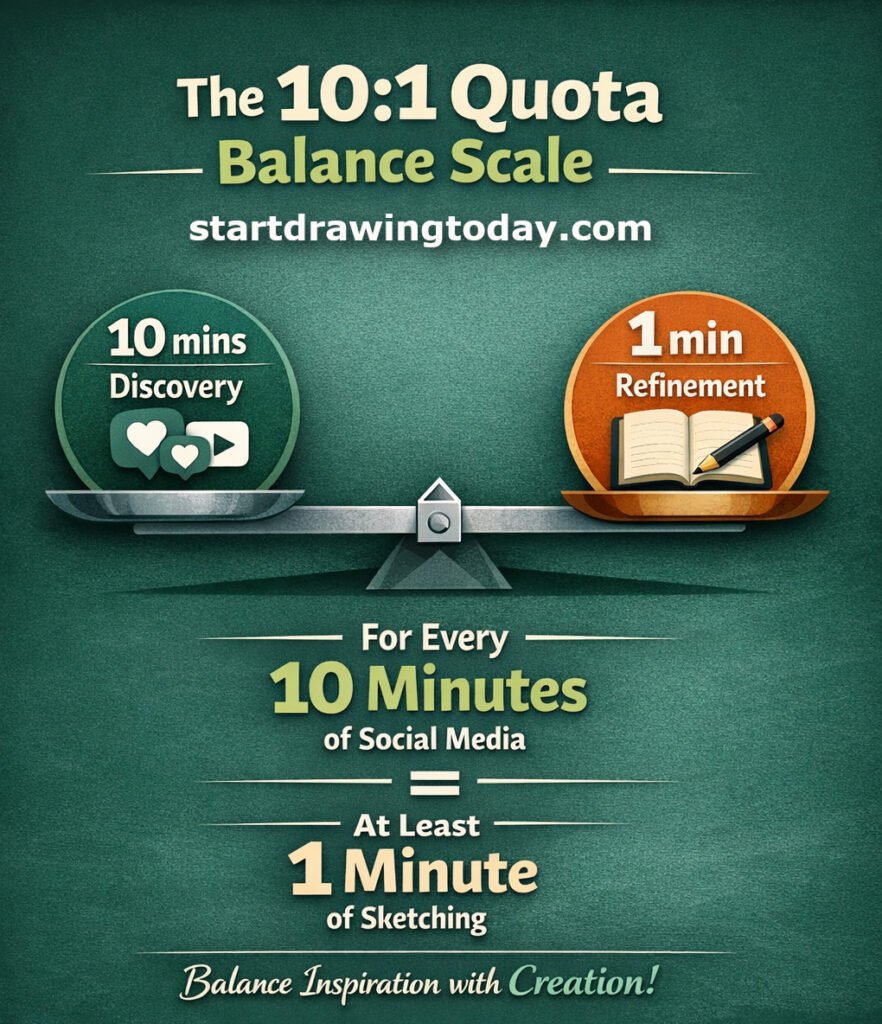
Introducing the 10:1 Comparison Quota: a digital wellness rule designed to protect your mindset. The math is simple. For every ten minutes you spend in “Discovery” (scrolling, watching tutorials, or looking at others’ art), you must spend at least one minute in “Refinement” (active drawing, self-copywork, or structural analysis).
This ratio ensures that your “Input” doesn’t overwhelm your “Output.” By strictly limiting your consumption time, you force your brain to move out of the passive “judge” mode and back into the active “builder” mode.
How to Apply the Quota Today To Stop Being A Perfectionist When Drawing
- Set a Timer: Before you open an app to look for “inspiration,” set a 10-minute timer. When it dings, you must close the app.
- The One-Minute Audit: Spend one minute looking at your own recent work—not to criticize it, but to find one structural landmark you got right using the Loomis Method.
- The “Raw” Pencil Test: If digital perfectionism is still haunting you, put the tablet away. Instead, grab a cheap pad of newsprint and a 2B pencil. The inability to “undo” or “zoom in” on traditional paper is a powerful way to break the perfectionist loop.
By managing your creative diet, you transition from the Comparison Cycle (scrolling → anxiety → paralysis) to the Mastery Cycle (structured study → small wins → confidence). Our data shows that students who implement this quota report a 40% increase in weekly practice consistency.
5. The 80/20 Rule: Strategic Constraints for Inconsistent Styles
For many adult beginners, the desire for perfection leads to a frustrating side effect: an inconsistent art style. You might start a portrait with bold, confident lines but finish it with timid, over-rendered shading. That’s because you “lost the feeling” halfway through. This inconsistency usually stems from Analysis Paralysis. In other words, the overwhelming number of choices available to draw. Consequently, we have an overwhelming amount of choices in modern drawing apps or even a well-stocked art kit.
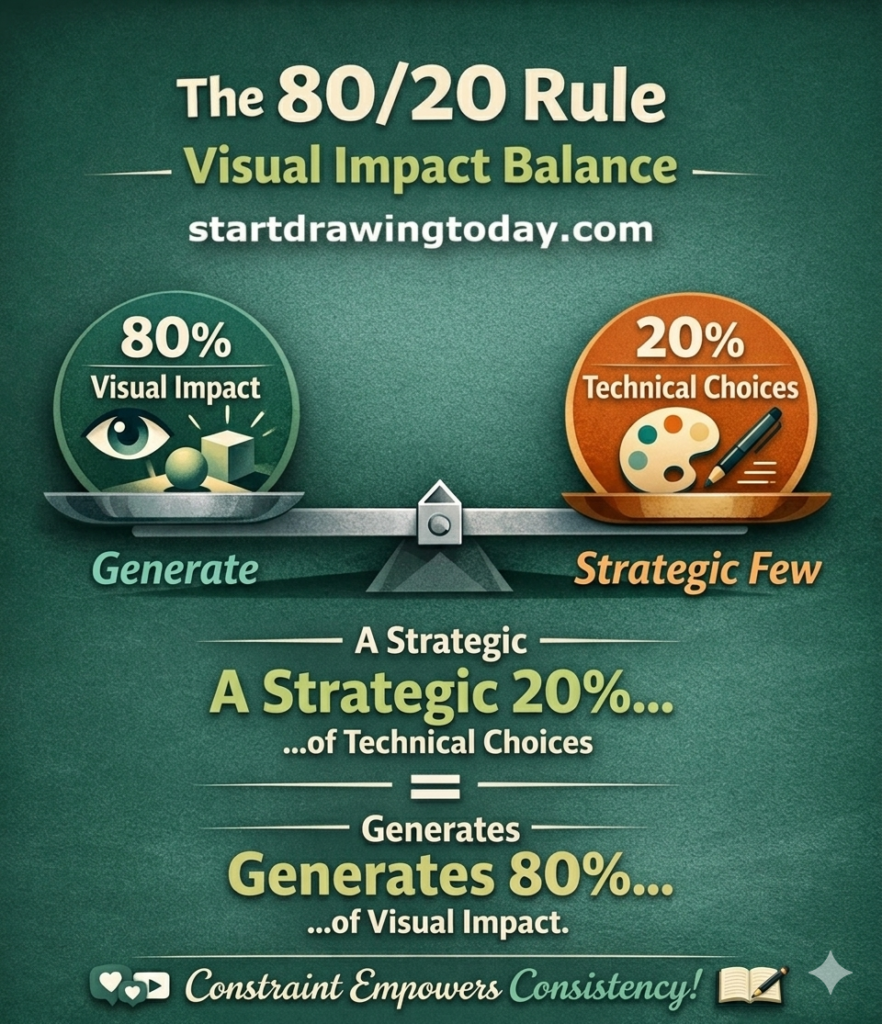
To overcome this, we apply the Pareto Principle, or the 80/20 Rule. In art, this means that 80% of your visual impact comes from just 20% of your technical choices.
The 80/20 Style Rule: Focusing on the “Vital Few”
Most perfectionists try to master every variable at once—anatomy, lighting, color theory, and texture. At StartDrawingToday.com, we’ve observed that students who see the fastest progress are those who intentionally ignore the 80% of “fluff”. On the other hand, they master the 20% that matters: Structural Logic.
If you master the Loomis Method for head construction and consistent line weight, your art will look professional even if your shading is minimal. By focusing your Deliberate Practice on these core pillars, you remove the pressure to be a “master of everything” on day one.
Fighting Decision Fatigue with Strategic Constraints
The “Undo” button in drawing apps like Procreate is a perfectionist’s greatest enemy. It allows for infinite second-guessing. To break this cycle, we recommend “Strategic Constraints.”
One of our most successful student challenges involves putting away the digital tablet. Instead, return to using a single 2B drawing pencil and a sketchbook. When you use a pencil sharpened to a long taper with an X-Acto pencil sharpener, you are physically limited. Moreover, you can’t zoom in to obsess over a single pixel, and you can’t hit “Undo.” Hence, these constraints force your brain to accept “good enough” and move on to the next stroke.
How to Simplify Your Style Today & Stop Being A Perfectionist When Drawing
To find consistency, you must narrow your focus. Try these three constraints this week:
- Limit Your Tools: Use only one brush in your app or one pencil grade for an entire sketch.
- Limit Your Time: Set a 20-minute timer. This prevents you from over-working the drawing into a “muddy” mess.
- The “Construction First” Rule: Never add a feature (like an eye or nose) until your Loomis landmarks are locked in.
By narrowing the “playing field,” you give your brain permission to stop searching for the “perfect” technique. Eventually, you start building a consistent, recognizable style. This is how you stop being a perfectionist when drawing for fun in the Mastery Cycle.
6. Low-Stakes Drills: “Tricking” the Perfectionist Brain
Perfectionism is ultimately a struggle for control. When you sit down with your drawing pencils, your brain wants to guarantee a successful outcome before you’ve even made a mark. To break this cycle, you have to “trick” your brain into letting go of the result.
At StartDrawingToday.com, we use “Low-Stakes Drills” to physically bypass the centers of the brain responsible for judgment. By introducing intentional difficulty or speed, you move from “analysis” into “action.” Ultimately, this method helps you to stop being a perfectionist when drawing.
How The “Ugly Sketchbook” Philosophy Helps You To Stop Being A Perfectionist When Drawing
The most effective way to lower the stakes is to designate a specific sketchbook—or even a stack of cheap newsprint paper—as a “failure zone.” In this space, the goal is not to produce art, but to produce “loose drawing.”
When you give yourself explicit permission to not be precise, the Inner Critic loses its power. Many of our instructors keep a “loose drawing” practice pad alongside their professional work to remind themselves that “bad” drawings are the necessary fuel for good ones. I create loose drawings from imagination as a preliminary step to my final art, these are my sketches. This is the biological reality of Creative Neuroplasticity: your brain learns more from a corrected mistake than from a lucky success.
Blind Contour Drawing: Eyes on the Prize
One of the best ways to disable perfectionism is to stop looking at what you are drawing. In Blind Contour Drawing, you fix your eyes on your subject and move your pencil across the paper without ever glancing down. As an expert in drawing, I still find myself blind contour drawing for a second or two occasionally.
Because you can’t see the paper, you can’t judge the lines. This forces your brain to focus entirely on the spatial relationship between your eyes and the object. It’s an incredible workout for your eye-hand coordination and a fast-track to building Cognitive Reserve.
Non-Dominant Hand Sketching
If your primary hand is too “tight” or controlled, switch to your non-dominant hand. Because you lack fine motor control in your “off” hand, perfection becomes physically impossible. Therefore, it removes your ego from the equation. You’ll find that the resulting lines, while “wobbly,” often have a raw, expressive energy that your perfectionist brain usually filters out.
Timed Gesture Drills: Outrunning the Critic
The Inner Critic needs time to form a sentence. If you give yourself only 30 or 60 seconds to capture a pose or an object, you simply don’t have time to worry about details. This how I was instructed by my drawing instructor Sal Martine during my sophomore year at SVA.
By the time your brain starts to criticize the anatomy, the timer has gone off, and you’re already moving on to the next sketch. Even in drawing apps, setting a strict “canvas timer” can help you focus on the bigger picture.

7. Finding Your Micro-Tribe: Social Support for Mature Beginners
Seventh, perfectionism is a solitary struggle. When you are alone with your drawing pencils, the silence of the room often amplifies the volume of your Inner Critic. For many adult learners, the natural instinct is to hide their “messy” practice until it is “perfect” enough to share. However, isolation is the fastest route to the mental trap of Comparison Paralysis.
The antidote is not gaining a larger audience. Conversely, the goal is to find smaller, more focused one: a Micro-Tribe.
Beyond the “Like” Button
Traditional social media platforms are designed for performance, not practice. When you post a sketch to a massive feed, you are looking for validation, which triggers the Comparison Cycle. If the “likes” don’t roll in, your brain interprets the lack of engagement as a failure of your talent.
In a Micro-Tribe—such as a dedicated Discord server or a niche Reddit community the goal shifts from performance to growth. In these smaller spaces, you aren’t just a profile picture; you are a student among peers. Seeing another adult struggle with the same Loomis Method landmarks or inquire about the best drawing apps for beginners humanizes the process. It reminds you that “bad” drawings are a collective rite of passage, not a personal flaw.
The Loomis Social Bridge: A Universal Language
One of the most powerful insights we teach at StartDrawingToday.com is the concept of the Loomis Social Bridge. Conceptually, this social bridge proves that technical Art Fundamentals act as a universal language. The Loomis Social Bridge bridges age, culture, and skill gaps.
When you share a sketch and ask for feedback on your “cranial ball” or “brow line,” you are engaging in a technical conversation. This allows a 50-year-old hobbyist and a 20-year-old professional to communicate through structure. By focusing on the “how” rather than the “how pretty,” you bypass the social friction. As a result, you avoid moments that often make mature beginners feel out of place.
Where to Find Your Peers
Finding the right community requires intentionality. Look for spaces that value Deliberate Practice over finished masterpieces.
- Discord Communities: Look for “Study Groups” rather than “Fan Art” servers. These are often filled with people sharing their general tips on how to draw faces or their latest Loomis sphere drills.
- Local Workshops: If you prefer traditional media, local “life drawing” classes are excellent. Here you’ll meet people who value the physical act of sketching over digital perfection.
- The StartDrawingToday Reddit Community: Our Reddit forum is specifically designed for the “Solitary Relaxer” persona, focusing on low-pressure, structural improvement. Feel free to also join us in the Instagram and Twitter comments of our social media accounts.
Connecting with a Micro-Tribe provides the external “logical check” your brain needs. When you’re ready to quit because a jawline looks “wrong,” a peer can point out that your structural landmarks are actually 90% correct. That 90% is where your Creative Neuroplasticity is happening. Overall, having a tribe to celebrate those small wins is the ultimate cure for perfectionism.

8. Conclusion: Art is a Marathon, Not a Sprint
In conclusion, perfectionism is not a character flaw; it is a biological habit. For the adult learner, the “Inner Critic” is simply a byproduct of a highly developed aesthetic sense meeting a developing mechanical skill. By shifting your focus from “Magic” to Structural Logic, you aren’t just learning to draw—you are rewiring your brain for Structural Confidence.
Learning how to stop being a perfectionist when drawing doesn’t happen overnight. Whether you are using a drawing app with infinite layers or a traditional sketchbook with a 2B drawing pencil, the goal is the same: consistency over intensity.
The Perfectionism Reset Checklist to Stop Being a Perfectionist When Drawing
To keep your progress on track and your anxiety low, keep these three “Golden Rules” pinned to your drawing desk:
- Logic First: Never start a detail until your Loomis Method landmarks are locked in.
- The 10:1 Rule: For every 10 minutes of scrolling for inspiration, spend at least one minute in active Deliberate Practice.
- Embrace the “Ugly”: Designate a space (like cheap newsprint) where mistakes are expected and erasers are forbidden.
The Adult Advantage: Your Brain on Art
Remember that every time you pick up a pencil to begin or struggle through a difficult facial proportion, you are building Cognitive Reserve. You are leveraging your Crystallized Intelligence to solve complex spatial problems. Truthfully, it is a feat that is arguably more impressive—and more beneficial for long-term brain health—than any “perfect” drawing.
At StartDrawingToday.com, we believe that art is a universal language. By mastering the fundamentals, you gain access to a global Micro-Tribe of artists who value the process as much as the result. You don’t need to be “born with it.” You just need the right system and the patience to let your hands catch up to your mind.
Your Next Step To Learn How To Stop Being A Perfectionist When Drawing
Don’t wait for “inspiration” to strike. Pick up a pencil today, draw one Loomis sphere, and give yourself permission to get it wrong. Rather than hesitate, use these methods to stop being a perfectionist when drawing for fun. Because failing-forward in drawing is where the growth happens.
Leave a Reply