Believe it or not, I was once a misguided art student who was struggling with your predicament. It’s the predicament of opening up your portfolio and scrolling through your recent artwork. One piece is a hyper-realistic charcoal drawing, the next is a vibrant, stylized cartoon. The one after that is a moody, painterly digital portrait. Overall, they all look great, but… they look like they were made by three different people. You are struggling with an inconsistent art style, and it’s making you feel like you haven’t found your artistic voice. I know this feeling. It’s the nagging doubt that you’re just a mimic, unable to commit to a single, recognizable look.
The truth is, having an inconsistent art style is not a sign of failure; it is a sign of intense, necessary growth. It means you are experimenting, learning, and absorbing influences. Most importantly, these steps are all crucial steps toward finding your unique voice. Your problem isn’t the inconsistency itself, but the lack of a system to filter those experiments into a cohesive style. My guide will use an Entity-First approach to show you how to turn your current experimentation into a signature style. A style created by focusing on constraints, repetition, and the true relationship between personal expression and fundamentals.
The Root Cause: The Experimentation Entity
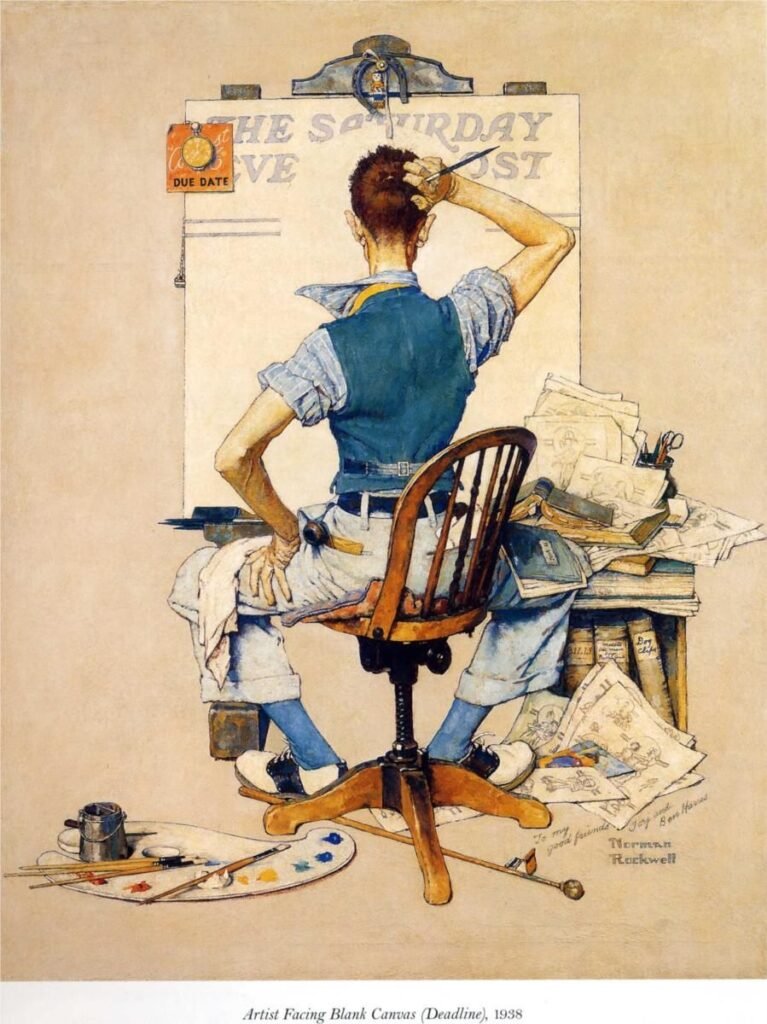
Above all, your inconsistent art style is a direct result of your artistic curiosity. You see something you like, and you try to replicate it. Keep in mind, this is a vital part of the learning process, but it can feel chaotic. Case in point: the artist’s confusion depicted in the Norman Rockwell painting above.
The Beginner’s Buffet: Why You Sample Every Style
As a beginner, you probably feel as if you’re standing in front of an artistic buffet. You sample a bit of everything: anime, realism, impressionism, concept art, etc. Sampling is necessary because you can’t know what you like until you’ve tried it. As a result, your style is likely to appear inconsistent because you are actively absorbing the visual language of dozens of different artists. So keep in mind, this beginning phase is about collecting visual tools, not building a house.
The “Fundamentals First” Lie
Many artists are told to focus only on perfecting their ability to use the fundamentals of art. Consequently, these are the type of students who expect that their style will magically appear. This expectation is false and this approach is a lie. Rather, style is an intentional achievement based on the way you choose to apply art fundamentals. Therefore, allow yourself to experiment with style as you learn art fundamentals simultaneously. Allow your style to be inconsistent while you learn art fundamentals and gradually discover your own artistic voice.

Mindset Shift #1: Define Your Non-Negotiables (The Constraint Entity)
First of all, artistic style is born from artistic constraint of options not abundance. In other words, when you have too many options, your style becomes scattered. Hence, fix your inconsistent art style by introducing deliberate limitations to your artistic approach. With that said, let’s examine each of those constraint options below.
The 80/20 Rule of Style: What 20% is Non-Negotiable?
Here’s how to use the 80/20 rule (Pareto Principle) for finding your artistic style. To begin, ask yourself: which 20% of your artistic choices yield 80% of your art style? Is it your line quality (sketchy vs. clean)? Your rendering method (cel-shading vs. soft blend)? Your subject matter (always faces)? Next, choose three distinct elements of style and apply them to every piece for a month. Before you know it, this forced consistency will start to turn your inconsistent art style into a signature look.
The Color Palette Constraint
Here’s a simple, powerful constraint technique to discover your style: limit your color palette. Choose 3-5 colors and use only those for a series of drawings. This’ll force you to solve visual problems with limited resources, resulting in a more cohesive look to your art. Definitely a key tool to have in your arsenal in order to combat an inconsistent art style.

Mindset Shift #2: The Power of Repetition (The Habit Entity)
Truthfully, a consistent style boils down to you as the artist maintaining a consistent habit. You develop a style by doing the same thing, the same way, over and over until it becomes automatic. Repetition is essential to resolving the problem of an inconsistent art style.
The 100-Heads Challenge
Commit to drawing 100 faces but consider this. For each face, apply your three non-negotiable style constraints. Draw them all with the same line weight, the same eye shape, or the same lighting setup. Gradually, by the time you reach face 100, you will have internalized those stylistic choices. As a result, they will start to appear naturally in your other work. This is how you turn a conscious numerical drawing target into an unconscious style.
The Copywork Cure for Inconsistency
Instead of copying other artists, copy your own favorite piece. Take the drawing you are most proud of and try to recreate it, paying close attention to the stylistic choices you made. For example, the way you drew the hair, the shape of the nose, the rendering of the shadows. Surprisingly, this self-copy work forces you to analyze your own emerging style and reinforces the elements you want to keep.
Mindset Shift #3: Style is a Filter, Not a Foundation (The Structure Entity)
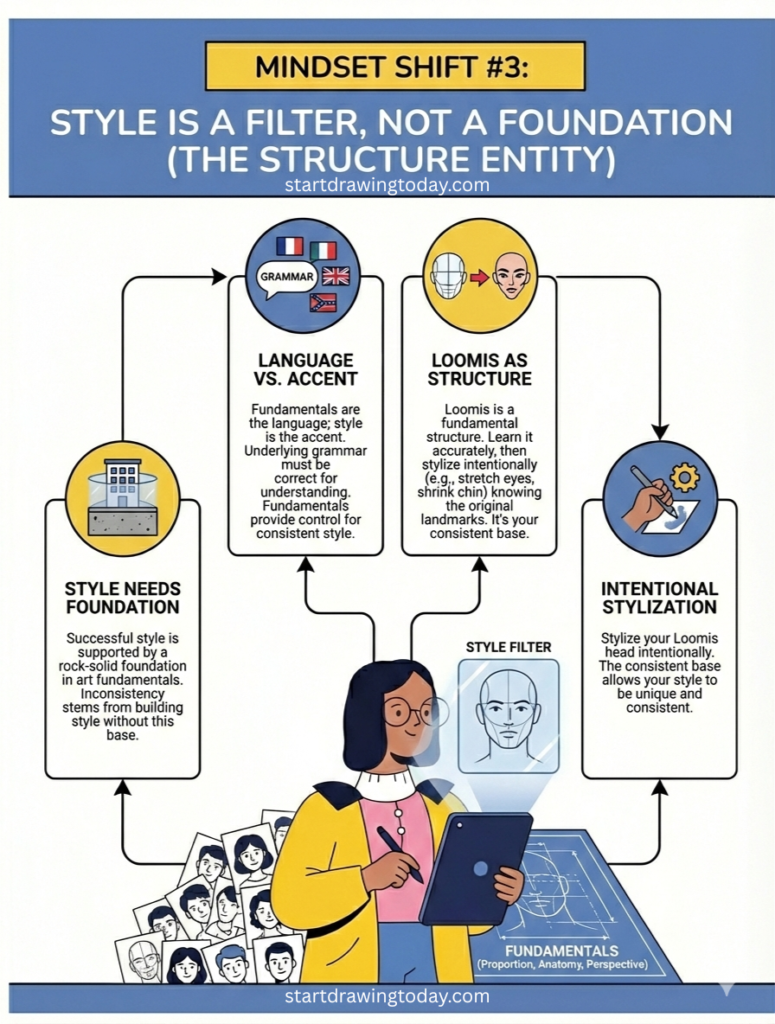
The most successful artists have a style that is supported by their rock-solid foundation in the fundamentals of art. Your inconsistent art style often stems from trying to build a style without the foundation.
Fundamentals as the Language, Style as the Accent
Think of drawing fundamentals (proportion, perspective, value, anatomy) as the language you speak. Furthermore, your style is the accent. You can speak the language with a French accent, a British accent, or a Southern accent, but the underlying grammar (the fundamentals) must be correct for people to understand you. Moreover, focusing on the fundamentals will give you the control you need to apply your chosen style filter consistently.
How to Use the Loomis Method to Develop Style
The Loomis method is a perfect example of a fundamental structure. Once you learn to draw the Loomis head accurately, you can then stylize it. For instance, you can stretch the eyes, shrink the chin, or exaggerate the brow bone. However, stylize your Loomis head intentionally, knowing where the original landmarks were. In turn, the Loomis method becomes the consistent base that allows your style to be consistently unique.

Recommended Resources for Developing Your Unique Style
To further enhance your expertise and provide a direct solution, here are the affiliate product recommendations:
- Mindset Book: Mindset: The New Psychology of Success (Amazon) – Helps you embrace the long-term process of style development and overcome the fear of an inconsistent art style.
- Construction Tool: A set of Blick Studio Drawing Pencils (Dick Blick) – Essential for practicing the 100-Heads Challenge and focusing on consistent line quality.
- Digital Tool: Procreate App (Apple App Store) – Excellent for quickly testing color palette constraints and applying consistent digital brushes to your work.
- Course: Introduction To Digital Character Design, a comprehensive course on character design and stylization (Alison.com) – Focuses on how to intentionally stylize the human form, which is the key to moving past an inconsistent art style.
Final Thoughts: Your Style is Already There
In conclusion, your inconsistent art style is not a problem; it’s a phase. In reality, you are most likely already collecting all the ingredients for your signature dish. Now, you just need to apply the filter of constraint and the heat of repetition. Stop worrying about looking like a different artist every week. Instead, embrace the chaos, define your rules, and keep drawing. Your unique voice is already there, waiting to be refined.