
My fellow artist, I know you know the feeling: you sit down at your desk, sketchbook open, pencil in hand. You have a brilliant idea, a clear vision, but your hand freezes. The blank page stares back, and a voice whispers, “Don’t mess it up.” That voice is the how to overcome the fear of drawing badly, and it is the single greatest obstacle to your artistic growth. I’m here to show you how to not only start drawing but to draw freely and joyfully.
I have been there. I have stared at that blank page for hours, paralyzed by the thought that whatever I put down would be a failure. Truthfully, this fear is not a sign of weakness. It is a sign that you care deeply about your art. However, caring too much can lead to blank page paralysis. My guide will use an Entity-First approach to break down the five critical mindset shifts you need to understand how to overcome the fear of drawing badly. As a result, you’ll hurdle the obstacles that prevent you from unlocking your creative potential.

How To Overcome The Fear Of Drawing Badly (The Perfectionism Entity)
The first step in learning how to conquer the process of how to overcome the fear of drawing badly is understanding where it comes from. It’s rooted in a toxic mix of perfectionism and a misunderstanding of how skill is acquired. Based on my observation, social media seems to play a stronger role in instilling this fear. It’s an unfortunate byproduct of how social media continues to affect some creatives and society.
Fixed Mindset vs. Growth Mindset (The Mindset Entity)
The biggest barrier is often a fixed mindset, a concept popularized by psychologist Carol Dweck. She says, a fixed mindset believes that talent is innate. You either have it or you don’t. When you operate from this mindset, every drawing becomes a test of your inherent talent. If the drawing is “bad,” it means you are a bad artist.
Conversely, a growth mindset understands that skill is acquired through effort and learning. Mistakes are not failures; they are data points. When you adopt this mindset, a “bad” drawing simply means you haven’t learned that particular lesson yet. I can confidently say that this is my mindset as an artist. This growth mindset shift is fundamental in learning how to overcome the fear of drawing badly.
The Toxic Self-Criticism Loop
Essentially, how to overcome the fear of drawing badly is amplified by a toxic internal critic. This critic compares your current, in-progress work to the finished masterpieces you see online. Consequently, you judge your work not by your effort, but by an impossible standard. Hence, this self-criticism creates the paralysis, making it impossible to even begin. Instead, you must learn to separate the “doing” from the “judging.”

Mindset Shift #1: Embrace the Ugly (The Process Entity)
First, the best way to begin understanding how to overcome the fear of drawing badly is to change your goal. Your goal should not be to create a masterpiece. It should be to simply be consistent and complete the process of creating your drawing.
The “Finished, Not Perfect” Rule For How To Overcome The Fear Of Drawing Badly
Perfectionism is the enemy of finality. The “Finished, Not Perfect” rule dictates that you prioritize completion over flawless execution. In contrast, you must instead give yourself permission to create imperfect art. A finished, imperfect drawing is infinitely more valuable than a perfect drawing that exists only in your head. Furthermore, I don’t know of any such thing as a “perfect” drawing.
In reality, many professional artists intentionally create “ugly” warm-up sketches to get the bad drawings out of the way. I’m one of them and it’s an important process of creating art I learned from my instructors. Sketches are a form of artistic inoculation which helps you learn how to overcome the fear of drawing badly.
The Power of the Process
To build genuine Expertise and Experience as an artist, you must focus on the process. Tracking your effort (as discussed in our previous article on validation), builds your history of success based on discipline, not luck. This history is your Trustworthiness marker. You can look back and say, “I showed up and put in the work, and succeeded.”

Mindset Shift #2: Lower the Stakes (The Habit Entity)
Honestly, a blank page is intimidating and can make you feel as if the stakes feel too high. With that said, let’s look at some ways you can lower the stakes at the beginning of a drawing. Lowering the stakes is the fastest way to control how to overcome the fear of drawing badly.
The 5-Minute Warm-Up For How To Overcome The Fear Of Drawing Badly
The goal of your first mark should not be to create a beautiful drawing. Instead, it should simply be to make a mark. Start every drawing session with a 5-minute warm-up.
- Draw 30-second gestures of figures.
- Fill a page with random, overlapping lines.
- Draw a simple object (like a mug) without lifting your pencil.
Moreover, these exercises trick your brain into moving past the initial fear. Once the page is no longer blank, the paralysis is broken. Then you will feel more confident to proceed with the rest of your drawing.
The Tiny Habit Approach Of How To Overcome The Fear Of Drawing Badly
Consistency in small amounts eventually results in achieving a big goal. Therefore, instead of committing to a two-hour drawing session, commit to drawing for just five minutes. If you feel like continuing after five minutes, great. If not, you still succeeded. This tiny habit approach builds consistency, which is helpful in learning to how to overcome the fear of drawing badly.
Mindset Shift #3: Redefine Failure (The Learning Entity)
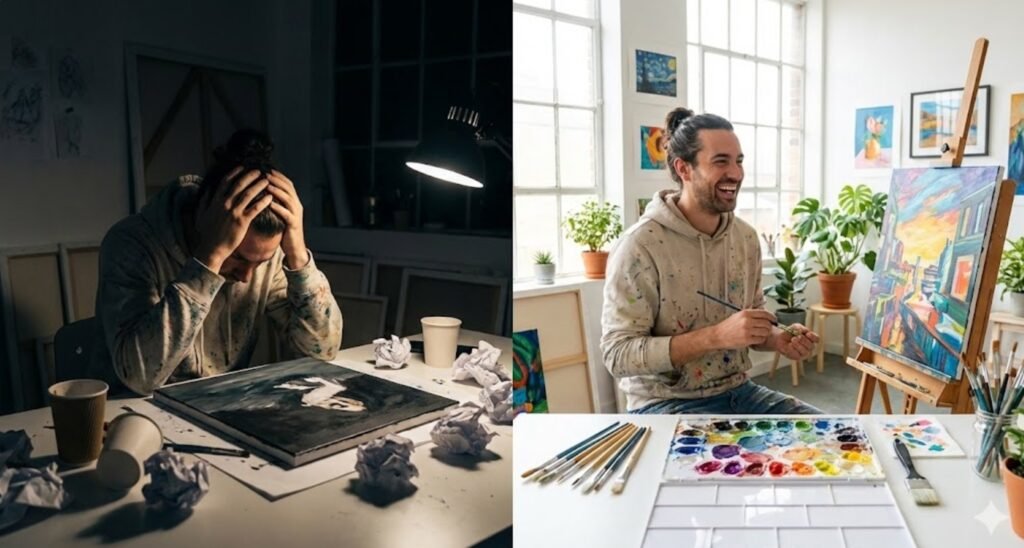
Thirdly, failure is only failure if you learn nothing from it. For an artist, a “bad” drawing is simply a drawing that has more to teach you. This is what I feel like telling MANY artists when I browse Reddit and discover so many posts by aspiring artists. They seem to have a misconceived perception that their art should look like what they see on social media. As a result, they become lost artistically.
Mistakes as Data: The Scientific Approach to Drawing
Adopt a scientific approach to your mistakes. When a drawing goes wrong, ask yourself:
- What is the specific problem? (e.g., The eyes are too high, the perspective is off, the shading is muddy).
- What is the rule I broke? (e.g., The rule of thirds, the principles of atmospheric perspective).
- How can I fix it next time?
Gradually, you shift the emotional response from:
“I am a bad artist”
to the analytical response:
“I need to study perspective more.”
This analytical approach will help you and is a great way of how to overcome the fear of drawing badly.
The Copywork Cure For How To Overcome The Fear Of Drawing Badly
If you are paralyzed by the need for originality, relax and instead give yourself permission to copy. Copying the masters of art and those who you admire is how artists have learned for centuries. Historically, it removes the pressure of invention. Furthermore, it builds your visual library and confidence, which are essential tools for creative freedom.

Mindset Shift #4: The Power of the Private Sketchbook (The Freedom Entity)
Fourthly, your fear of drawing badly is most likely related to the fear of others seeing you draw badly. Fortunately, you can make the following adjustment: minimize the audience, and you minimize the fear. Just vet your audience and be more selective on who you show you drawings to.
Drawing for Yourself: Why Your Sketchbook is Not a Gallery
Your sketchbook is your laboratory, your playground, and your private journal. It is not a gallery, unless you want it to be. Therefore, treat it as a safe space where judgment is forbidden. Sketchbook drawing is how I eventually found and became comfortable with my style. In college, it was a free space for me to draw and not worry about criticism.
For example, dedicate one sketchbook solely to “ugly” drawings. The only rule is that you cannot erase or judge the result. This exercise in pure, uninhibited creation is incredibly liberating. In addition, It is a great way to understand how to overcome the fear of drawing badly.
The “Art Comparison Trap” Antidote
Previously, we discussed in a separate post about the Art Comparison Trap which thrives on public display. By keeping your experimental work private, you protect your fragile creative self from the toxic external pressure that fuels social media. However, there will come a time that you need to gradually come out of your shell.
Mindset Shift #5: The 80/20 Rule of Drawing (The Efficiency Entity)
Fifth, focusing on the fundamentals gives you the confidence to tackle any subject. This is the ultimate way to conquer the how to overcome the fear of drawing badly.
Focus on Fundamentals Of How To Overcome the Fear of Drawing Badly
The 80/20 rule (Pareto Principle) suggests that 20% of your effort yields 80% of your results. In drawing, the 20% are the fundamentals:
- Form and Perspective
- Proportion and Anatomy
- Value and Composition
In fact, mastering these core concepts will give you the technical certainty to approach any drawing challenge. When you know why something looks wrong, you are no longer afraid of it. You are simply presented with a problem you know how to solve.

Recommended Resources for Building Creative Confidence
To further enhance your expertise and provide a direct solution, here are my product recommendations:
- Mindset Book: Mindset: The New Psychology of Success (Amazon) – The definitive book on adopting the Growth Mindset Entity to conquer the how to overcome the fear of drawing badly.
- Process Tool: A set of Blick Studio Drawing Pencils (Dick Blick) – Low-cost, high-quality tools for daily, low-stakes warm-ups and exercises.
- Confidence Course: “How To Draw 101” is a comprehensive course focused on creative freedom and overcoming blocks (Alison.com) – To master the Confidence Entity and build artistic self-worth.
Final Thoughts: The Unstoppable Artist
In conclusion, your notion of how to overcome the fear of drawing is basically a phantom. In fact, it is a voice based on old, fixed ideas about talent. The moment you decide that your goal is to learn, not to be perfect, you become unstoppable. You have the power to conquer the fear by simply showing up and making a mark. Your journey is about progress, not perfection. Now, go express yourself freely with drawing and celebrate the learning that comes with it!