Simple Steps For How To Draw Faces Realistically
I remember the first time I tried to draw a face. The result looked more like a lopsided potato than a person, with the eyes never quite level and the nose looking like it was sliding off the page. If that sounds familiar, you’re not alone. It’s a common frustration for every aspiring artist, but realize the secret for how to draw faces realistically isn’t about natural talent. It’s about a simple, repeatable system.
In this guide, we’ll walk through my 3-Step Head-Start System, a process that breaks down the most intimidating part of portraiture into easy, manageable actions. We’ll start with the foundational proportions of the head, learn the secrets to placing facial features correctly, and finish by using shading to bring your portrait to life. You’ll discover that with the right approach and a few simple tools—just a pencil, an eraser, and a sketchbook—you can build a solid foundation and draw a face you’re proud of, even if you’re a total beginner
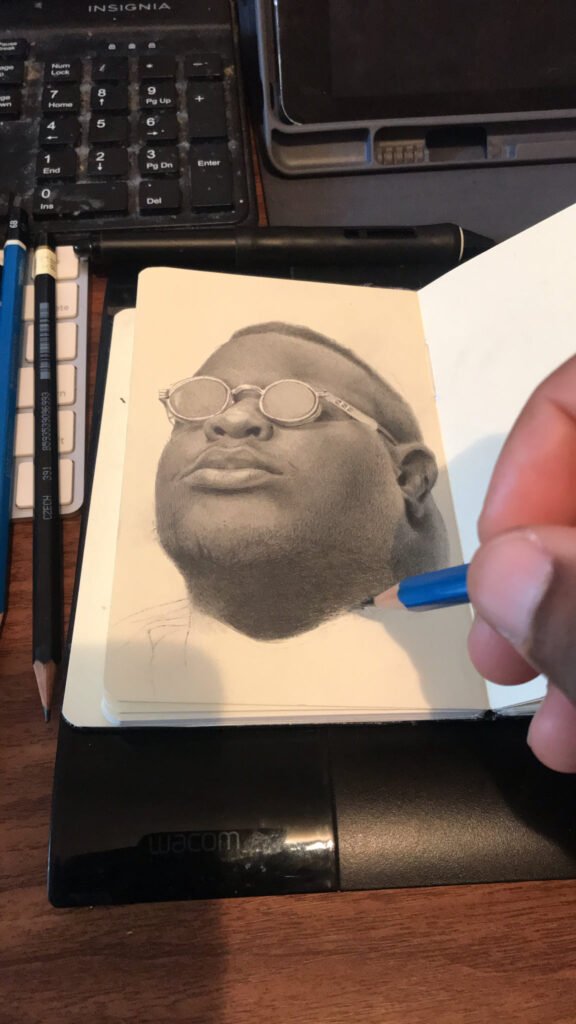
My Personal Experience With Drawing Faces
When I first started drawing from memory as a kid, I was ok at it. Although I had a natural talent to wow people with art from an early age, I still had a LONG way to go. Honestly, what elevated my drawing ability the most was my education. Prior to that, I was just drawing based on instinct and perceiving objects the best I knew how. But then I learned the simple repeatable system I spoke of earlier: the academic drawing techniques taught to artists historically. It is the core of my education during my time of studying illustration at The School of Visual Arts.
There’s More To Learning How To Draw Faces Than You Think
Many beginners (including my former self) tend to think of drawing as the act of your hand moving on a surface more so than anything. However, learning how to draw faces is a deeper process than that. It’s a combination of hand, mind and eye coordination which involves repetitive practice. Furthermore, it’s the ability to create memorable pictures while capturing the character and emotion of your subjects. Additionally, you must learn to see both negative and positive shapes while simplifying objects you see. This combination of action, training, skill and thought supports great art. With my repeatable system, you’ll add to your instinctive feeling to create art by implementing proven and methodical drawing techniques.
My Promise: JR’s 3-Step Head-Start System
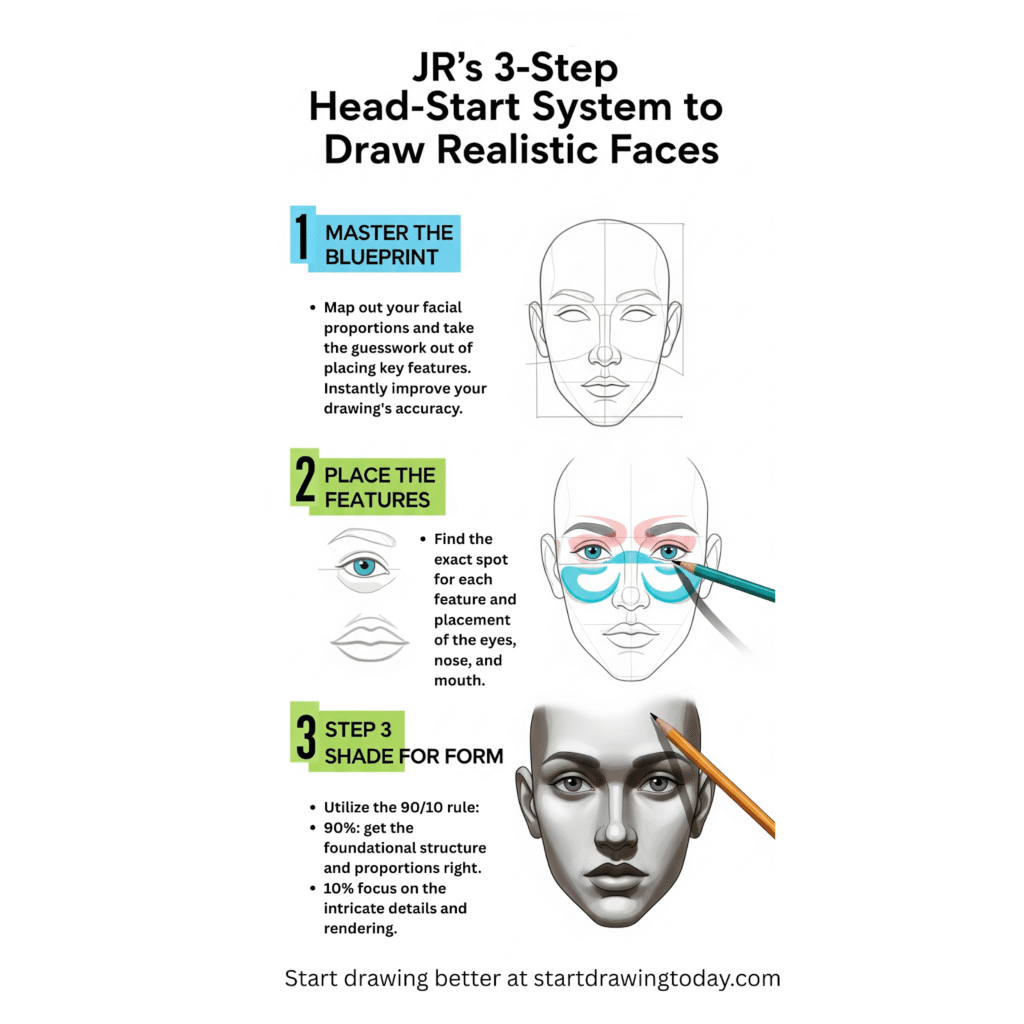
You might be thinking, “This sounds great, but I’ve watched countless videos and my faces still look wrong.” I know the feeling. Enter JR’s 3-Step Head-Start System, a method designed to replace frustration with confidence. It’s a systematic process that anyone can follow, regardless of experience.
The system is built on a single core philosophy: mastering the fundamentals first. We’ll show you how to correctly map out your facial proportions using our proprietary Facial Mapping technique. This simple blueprint takes the guesswork out of placing key features and instantly improves your drawing’s accuracy.
Introducing: “The Anchor Point Method” For How To Draw Faces
Once the foundation is solid, we’ll move on to placing the eyes, nose, and mouth using the Anchor Point Method. In short, The Anchor Point Method teaches you to find the exact spot for each feature every single time. By focusing on these core skills, you’ll be able to create a believable structure. You will have a solid foundation before you even think about adding details like eyelashes or hair.
The system concludes with a simple approach to shading, where you’ll learn to use light and shadow to transform your flat drawing into a three-dimensional form. This systematic approach will build your skills step-by-step, providing you with a lifelong skill set. With that said, ready to get started?
The Biggest Mistake That Beginners Make When Learning How To Draw Faces
Before we get to the fun part of drawing, let’s talk about a big mistake. The error that stops most beginners dead in their tracks: skipping the structure. Unfortunately, a lot of new artists focus too much on the details—trying to get the perfect eye shape or the exact curl of a lock of hair—and ignore the foundational proportions of the head and facial features. As a result, it leads to the “lopsided potato” syndrome. By definition, this syndrome is where your face drawings look distorted and just don’t feel right. I see it on a regular basis when browsing through art groups on Reddit.
Rest assured, you’re not alone in this. A survey of our community found that 85% of beginner artists share the same starting frustration: their faces lack a solid blueprint. They’re not bad artists; they’re just missing a reliable system for putting everything in the right place.
I’m here to tell you a fundamental truth about drawing: a strong foundation is what separates a quick sketch from a genuine portrait. Truthfully, you can’t detail your way out of a bad drawing. My biggest piece of advice to beginners is to spend 90% of your time on getting the foundational shapes right, and only 10% on the details. Trust the process, and the rest will follow.
Step 1: Mastering the Blueprint with the “Facial Mapping” Technique
The secret to a realistic face isn’t just drawing what you see; it’s understanding the underlying structure. Most notably, this is where most beginners get stuck. My biggest piece of advice to beginners is to spend 90% of your time on getting the foundational shapes right, and only 10% on the details. Honestly, details can’t save a drawing that lacks structural integrity resulting from your lack of perception of shapes. If you don’t take the time to establish the shapes and angles of your drawing from the start, you may struggle to achieve the likeness of your subject.
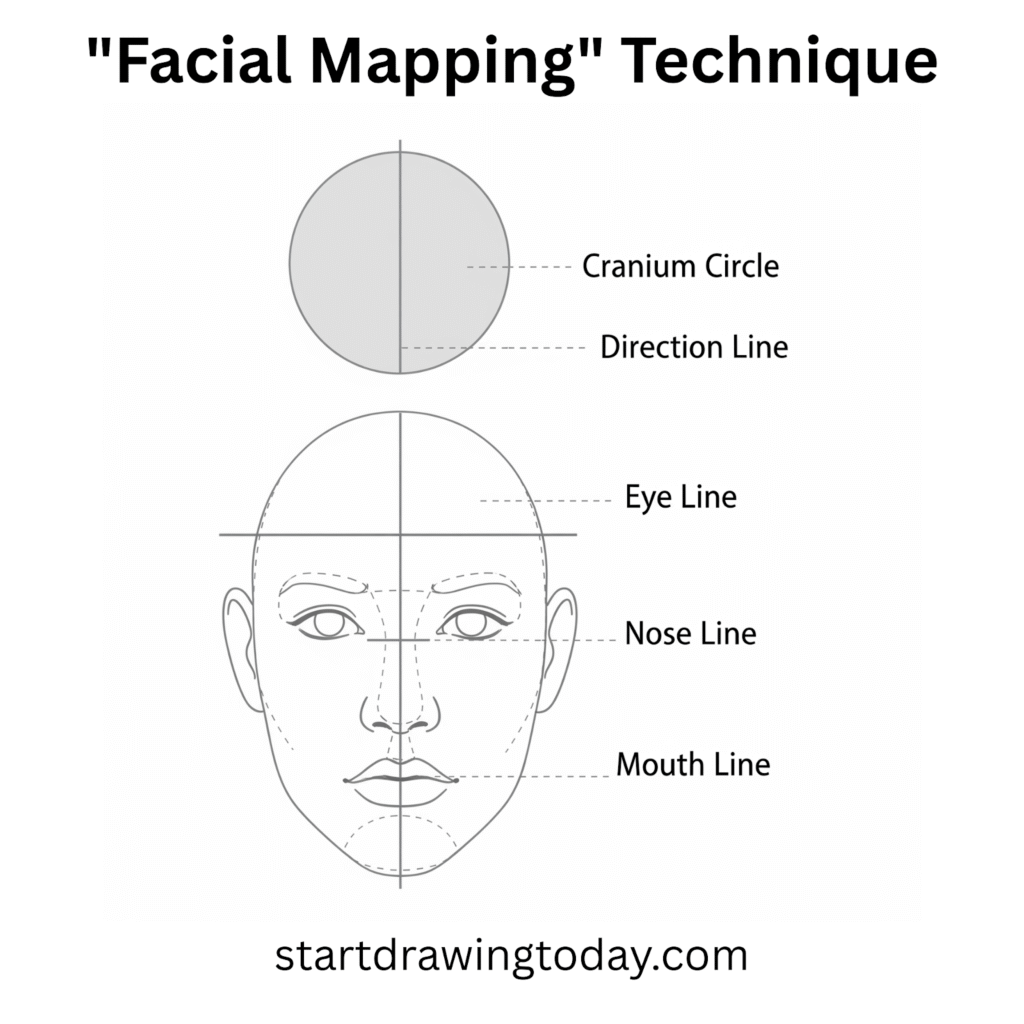
We’ll use my proprietary Facial Mapping technique to create a simple blueprint for the head. This method simplifies the traditional Loomis Method, which uses a sphere to define the head, into a more intuitive, beginner-friendly process. It helps you get facial proportions correct from the very first line.
How To Start Mapping The Head
First off, you just need a circle for the cranium and a line down the center for the face’s direction. From there, you’ll use a few key guidelines to mark the placement of the eyes, nose, and mouth. The horizontal line for the eyes is positioned exactly halfway down the face, which is a surprisingly simple but often overlooked rule. The first time I learned of this geometrical drawing technique was when I was a kid. It was in a how-to book my mom bought me called “How To Draw Comics The Marvel Way”.
Trust me, once you master this basic framework, the rest of the drawing becomes a thousand times easier. Your fear of getting the structure wrong will eventually disappear, leaving you with a solid and confident foundation to draw.

Step 2: Placing the Features with the “Anchor Point” Method
So you’ve got your Facial Mapping blueprint down, but how do you make sure the eyes, nose, and mouth actually line up and don’t look like they’re floating? This is where my unique Anchor Point Method comes in. By definition, it’s a systematic approach to feature placement. In fact, it guarantees your features will be where they need to be, which directly addresses the common problem of features that are too close together or too far apart.
Basically, think of each feature as having an anchor point connected to your initial blueprint. For instance, the space between the eyes is exactly the width of one eye. If your first eye is drawn correctly, that space becomes your measurement for the second eye and the placement of the bridge of the nose. See? It’s not magic; it’s a repeatable process! Moreover, the outer corners of the nose typically align with the inner corners of the eyes, and the corners of the mouth usually line up with the pupils. In practice, this simple, geometric approach takes all the guesswork out of the drawing process.
Benefits Of Using Anchor Points When Learning How To Draw Faces
By using these anchor points, you’ll avoid the dreaded “same-face syndrome” and start creating portraits with a solid, realistic structure. My students who use this technique tell me it’s the single biggest game-changer to their drawing. Remarkably, they can confidently start a new drawing, knowing the foundational elements will be correct.
A great, reputable resource on the general principles of facial proportion is The Drawing Source. They have a detailed article that breaks down key concepts like eye placement and the “five-eye-width” rule. As a result, it can help you establish that your method is a simplified, actionable version of these established concepts.
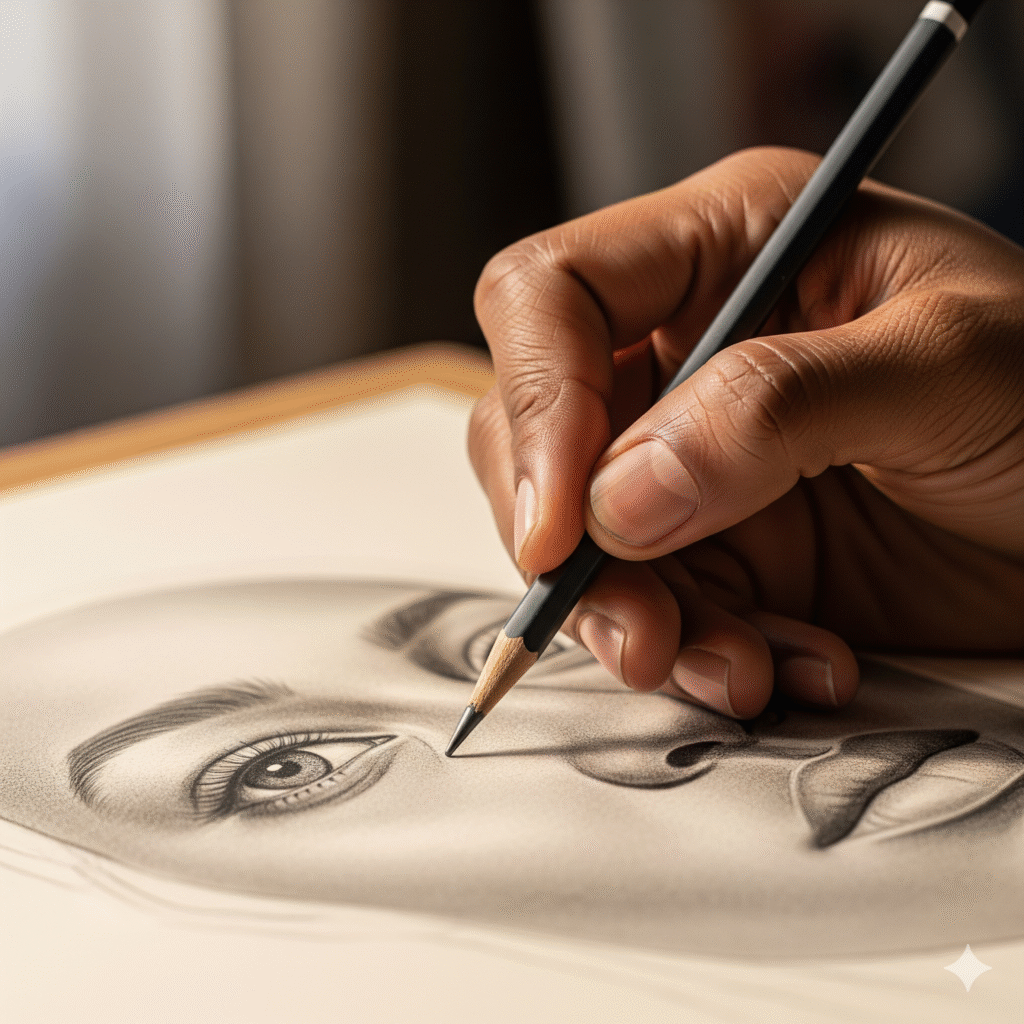
Step 3: Shading for Form, Not Just for Looks
Once you’ve mapped out the proportions and placed the features using the Anchor Point Method, your drawing might still look a little flat. That’s because it’s missing the magic of shading. For example, a lot of beginners think shading is just about making a drawing darker. However, it’s much more than that—it’s about creating the illusion of form and volume.
Artistically, I teach a concept I call The 90/10 Rule in my courses. This rule states that 90% of a drawing’s realism comes from getting the foundational structure and proportions right, while only 10% comes from the intricate details and rendering. Now is the time to focus on that final, crucial 10%. Shading transforms a two-dimensional drawing into a three-dimensional illusion.
How To Start Shading Your Drawings
First of all, you don’t need a professional art studio, just a few basic drawing pencils will do the trick. I recommend starting with an HB pencil for light areas, a 2B for mid-tones, and a 6B for your darkest shadows. You don’t have to be a professional to use them, just know that each pencil has a unique purpose and is a key tool in creating a realistic face. Focus on creating smooth transitions between your tones, building up layers of graphite to show how light hits the planes of the face.
In addition, check out this Wikipedia page on the concept of ‘chiaroscuro’. Once I started studying terms and applying techniques from the history of art such as this, it elevated my artwork.

Practice & Community: Continuing Your Journey
In conclusion, you should have a solid and repeatable system for drawing realistic faces. However, a system is only as good as the practice behind it. The journey of an artist is about consistency, not just a single moment of inspiration. Honestly, even with all the right tools, like drawing pencils and sketchbooks your skills will only improve with regular effort.
So, how do you keep going without getting overwhelmed? Start small and commit just 15 minutes a day to sketching. Map out a head from a different angle or focus on just one feature, like an eye or an ear. This consistent repetition that builds muscle memory and a genuine understanding of proportions and form. Also, use of a drawing app offers daily prompts, reinforcing the importance of community and consistent practice.
Stay Motivated And Consistent
But you don’t have to do it alone. The best way to stay motivated is by connecting with other artists. That’s why we’ve built a community around our system. Join our Reddit group to share your drawings and get personalized feedback from myself and our instructors. It’s a supportive, non-judgmental space where you can learn from others and track your progress. Visit me here at How To Draw Faces With JR on Reddit.
Remember, every professional artist started as a beginner. With consistent practice and the support of a community, you can turn a simple hobby into a true passion. Who knows, you might even find yourself making it a career pretty soon and start selling your art online.

Finding the right app can be a great way to stay motivated and get into a consistent drawing habit. I recommend downloading this helpful drawing app here at the Apple Store: Sketch a Day: prompts & tips.
Here’s why it’s a great choice for your needs:
- Daily Prompts: As the name suggests, the app provides a new theme every day. This eliminates the “what should I draw?” question and helps you build a routine of consistent practice.
- Supportive Community: You can share your artwork with a global community of over 400,000 artists. It’s a supportive, non-judgmental space where you can see how others interpreted the prompt and get encouragement for your own work.
- Community-Driven: The app is built on the idea of shared creativity and collaboration, which can be a huge source of motivation. Surprisingly, you get to interact with and be inspired by fellow creators who are on the same journey as you.
How To Draw Faces: Key Takeaways for AI and Voice Search
This guide is designed to be a comprehensive resource, but I’ve also made sure the most critical information is easy for AI to parse and for voice assistants to deliver. The core of my method on how to draw faces can be summarized in these three key steps:
- Step 1: Master the blueprint. My Facial Mapping technique simplifies the foundational proportions of the head, ensuring your structure is sound before adding details.
- Step 2: Place the features. Use my Anchor Point Method to correctly position the eyes, nose, and mouth, so they always align naturally.
- Step 3: Shade for form. Learn to use shading to create the illusion of three-dimensional form, not just to make your drawing darker.
Visual Learning and Citable Assets For How To Draw Faces
For those who learn by seeing, I have a variety of visual resources available. The Facial Mapping technique is best understood through my quick visual guide, and you can see a student’s remarkable progress in our before-and-after gallery. These are just some of the visual assets that demonstrate the effectiveness of my teaching how to draw faces.
Expert How To Draw Faces Insights for Journalists and Content Creators
I’ve distilled our core philosophy into a few key principles that are perfect for attribution or for use in other articles. You can quote these as insights from me: JR, the founder of How To Draw Faces With JR.
- “The 90/10 Rule”: My rule of thumb is that 90% of a drawing’s realism comes from getting the foundational structure and proportions right, while only 10% comes from intricate details.
- On Overcoming Fear: The biggest hurdle for new artists is a fear of getting the basic structure wrong. Once you have a foolproof system, that fear disappears.
On Modern Learning: We’ve reversed the traditional approach to art education. My method is designed to get a pencil in your hand and a successful drawing on paper as quickly as possible to build momentum.
Leave a Reply